
Key takeaways
Jump to a section
Casein and whey are milk proteins sold in different powder formats. This guide compares their labels, the digestion research cited on the page and practical choices such as texture, timing and price.
Where they both come from
When milk is processed, it separates into two protein fractions. Roughly 80 per cent is casein and about 20 per cent is whey. Both are considered “complete” proteins, meaning they supply all nine essential amino acids your body cannot make on its own.
Whey is the liquid left over after milk curdles; casein is the curd itself. That origin story is not just trivia — it explains everything about how they behave once you eat them.
Digestion speed
The ISSN position stand on protein and exercise (Jäger et al., 2017) describes whey as water soluble and rapidly digested, and casein as water insoluble, coagulating in the gut and digested more slowly than whey. It cites work in which a 30 g dose of whey produced a pronounced rise in blood amino acids that had returned to baseline by 300 minutes, while a 43 g dose of casein produced a slow rise that was still above baseline after 300 minutes.
The terms “fast” and “slow” protein are used to describe this difference in digestion speed.
Leucine in whey and casein
Leucine is one of the three branched-chain amino acids. The ISSN position stand (Jäger et al., 2017) reports that whey and casein routinely contain the highest leucine content of all other protein sources, at 11% and 9.3%, respectively.
Casein before bed
Casein is commonly associated with a before-bed routine. The ISSN position stand (Jäger et al., 2017) reports that results from several investigations indicate that 30–40 g of casein protein ingested 30 minutes before sleep or via nasogastric tubing increased overnight muscle protein synthesis in young and old men, respectively. Just keep in mind that no EU-authorised health claim distinguishes between “fast” and “slow” protein sources.
Does timing actually matter?
The International Society of Sports Nutrition’s position stand on protein and exercise (Jäger et al., 2017) says that total protein and calorie intake appears to be the most important consideration for positive adaptations to resistance training, and that the impact of timing strategies (immediately before or immediately after training) in non-athletic populations appears to be minimal.
The ISSN position stand (Jäger et al., 2017) notes that the benefits of protein timing around a workout seem to be lessened for people who already eat appropriate amounts of protein (for example 1.6 g/kg/day or more). Spreading adequate protein across three or four meals or snacks is a common approach.
Some people who routinely go eight or more hours without eating — overnight being the obvious example — include a protein-rich food at their last meal. Casein is one option; a high-protein meal of any kind (eggs, Greek yoghurt, cottage cheese, meat, a shake) is another.
Practical differences you will actually notice
Mixability and texture
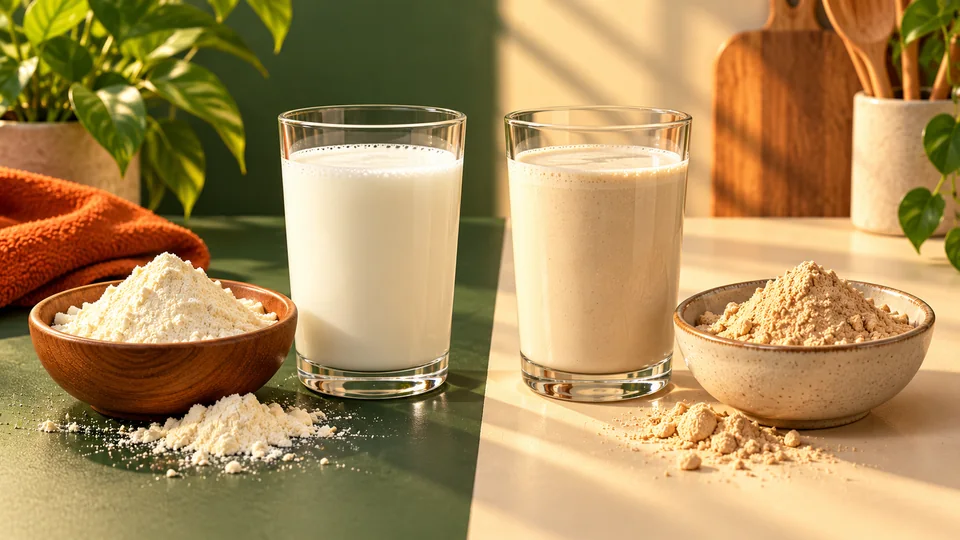
Whey mixes thinly and cleanly in water or milk — shake it in a bottle and you have a smooth drink in seconds. Casein mixes thick, often to a pudding-like consistency, especially with less liquid. Some people love this; others find it hard work. Casein can be stirred into a pudding or overnight oats; whey stays thin in a shaker.
Blends
Some products combine both proteins, attempting to get a faster initial rise in amino acids from whey with a longer tail from casein.
Which should you choose?
The ISSN position stand (Jäger et al., 2017) reports that in one study, whey protein ingestion was followed by greater muscle protein synthesis than casein at rest and after resistance exercise, and says total protein and calorie intake appears to be the most important consideration for positive adaptations to resistance training.
- Choose whey if you prefer a thinner texture. Whey mixes thinly in water or milk.
- Choose casein if you prefer a thicker texture or want an option commonly used before a long overnight fast.
- Use both if your diet and budget allow — whey around training and casein in the evening is one pattern.
- Eat more whole-food protein if you are already close to your daily target and wondering whether a different supplement type will unlock extra results. Cottage cheese, Greek yoghurt and eggs are all high in casein.
Our guide to how much protein you need each day covers how to set a daily target; the fast-vs-slow comparison above is a separate question.
A note on the bigger picture
Phrases such as “prevents muscle breakdown overnight” or “anti-catabolic” are marketing framings, not EU-authorised wording. The EU-authorised protein wording is shown below.
If you are new to thinking about protein intake, the whey protein guide hub covers the fundamentals clearly, including when to take whey and how it compares to plant-based alternatives. And if you are weighing up supplementation more broadly, the supplements for muscle gain guide puts protein in context alongside everything else.
Related: Whey protein: the complete guide · Best time to take whey protein · How much protein you actually need each day · Supplements for muscle gain.
Frequently asked questions
Is casein protein better than whey for building muscle?
Both are milk proteins. The exact EU-authorised wording is shown in the box on this page. Jäger et al. (2017) describe whey as rapidly digested and casein as digested more slowly, with leucine content of 11% for whey and 9.3% for casein. The ISSN position stand (Jäger et al., 2017) says total protein and calorie intake appears to be the most important consideration for positive adaptations to resistance training.
Should I take casein protein before bed?
It's a choice rather than a rule. The ISSN position stand (Jäger et al., 2017) describes casein as coagulating in the gut and digesting more slowly than whey, and casein is often used before a long overnight fast. Greek yoghurt, cottage cheese and eggs are other options. The exact EU-authorised wording is shown in the box on this page.
Can I use whey protein instead of casein at night?
Some people do. According to the ISSN position stand (Jäger et al., 2017), whey is digested more quickly than casein, and total protein and calorie intake appears to be the most important consideration for positive adaptations to resistance training.
What's the difference between whey and casein in terms of texture?
Whey mixes thinly and smoothly — the classic shake texture. Casein mixes thick, often approaching a pudding consistency, particularly with less liquid. Casein can be used to make high-protein overnight oats or puddings.