
Key takeaways
Jump to a section
Whey is a milk-derived protein sold in several powder and drink formats. Use this guide to compare types, labelled quantities, dietary suitability and cost, then follow the links for specific questions about timing or precautions.
This hub is the map. Below you’ll find what whey actually is, how much protein you need, when to take it, who it’s for, and how to use whey protein day to day. Each section gives you the working answer and then points you to a deeper guide if you want the full story.
What whey protein actually is
Whey is one of the two proteins in milk (the other is casein). During cheese-making, milk separates into curds and a watery liquid — that liquid is whey. For decades it was treated as a by-product; today it’s the foundation of the most popular protein powders on the market. Filter it, concentrate it and dry it, and you get the powder you stir into a shaker. Because it comes from milk, whey protein is a complete protein: it contains all nine essential amino acids your body can’t make on its own and has to get from food. That completeness is a defining feature of whey protein.
Amino acids and leucine
Amino acids are the building blocks proteins are made from. Of the essential nine, three are branched-chain amino acids (BCAAs) — leucine, isoleucine and valine. Leucine is the one that gets the most attention in sports nutrition. Whey is also one of the most widely used protein powders among active people. If you want to understand the amino acid side in more detail, our BCAA and amino acids guide breaks it down.
Why “complete” matters
Plenty of foods contain protein, but not all of it is equally usable. A complete protein like whey gives your body the full set of building blocks in good proportions, which is why whey works well as a protein source.
Isolate vs concentrate: which whey is which
Walk down any supplement aisle and you’ll see two main types of whey protein, and the difference is mostly about processing.
Whey concentrate
Concentrate is whey filtered to a point where it’s typically around 70–80% protein by weight, retaining a little more of the natural carbohydrate (lactose) and fat from milk. It tends to taste richer and creamier, costs less, and works perfectly well for most people most of the time.
Whey isolate
Isolate is filtered further, usually to 90%+ protein, stripping out most of the carbohydrate and fat — including most of the lactose. That makes it a sensible pick if you’re watching every gram. It’s leaner and lighter, often at a slightly higher price.
Neither is “better” in a vacuum; it depends on your budget, your stomach and your goals. We’ve written a full side-by-side so you can decide with confidence — see whey isolate vs whey concentrate: which should you choose.
How much protein per day do you actually need
The ISSN position stand on protein and exercise (Jäger et al., 2017) states that, for building and maintaining muscle mass, an overall daily protein intake of 1.4–2.0 g per kilogram of bodyweight is sufficient for most exercising individuals. For an 80 kg person training a few times a week, that’s roughly 110–160 g a day.
Where whey fits
You don’t need whey protein to hit those numbers — whole foods can get you there. But hitting a high protein target purely through food can mean a lot of cooking, chewing and planning. A scoop of whey is one option among others for closing a gap in the day’s protein. It’s a tool, not an obligation.
Per-meal protein
It also helps to think per-meal, not just per-day. The ISSN position stand (Jäger et al., 2017) notes that recommendations for protein per serving, for athletes aiming to maximise muscle protein synthesis, are mixed and depend on age and recent resistance exercise, with general recommendations of 0.25 g of a high-quality protein per kg of body weight, or an absolute dose of 20–40 g. Spreading intake across the main meals is one way to make the daily total achievable without one enormous protein bomb at dinner.
Our deep dive walks through how to work out your number: how much protein do you actually need each day.
Best time to take whey protein
Here’s the short version: the ISSN position stand (Jäger et al., 2017) says that the daily amount of protein intake seems to operate as a key consideration because the benefits of protein timing around the workout seem to be lessened for people who are already ingesting appropriate amounts of protein (e.g. ≥1.6 g/kg/day).
Around training
A whey shake is whey protein powder mixed into water or milk, and it can be drunk after a workout. Before training works too if that suits your stomach better.
Across the day
Protein can be spread across meals — roughly every few hours. A whey shake can be drunk with a low-protein breakfast or as a snack. For the full breakdown of timing scenarios, read our best time to take whey guide.
The authorised claims for protein
Those are the claims we stand behind for whey protein, because whey is a complete protein. See our summary of the whey protein research, part of the CapyFuel evidence library, for how each claim is supported.
What that means in practice
Whey is one option among others for adding protein toward that intake.
What whey is not
Whey is not a fat-loss product, not a medicine, and not a substitute for training or a sensible diet. Anyone promising body transformation in a tub is selling a story. We’d rather you trust us with the boring truth. For a measured, claim-by-claim look, see our whey protein benefits guide.
Whey, lactose and digestion
Because whey comes from milk, it contains some lactose. The amount varies by type.
If lactose bothers you
Whey isolate has most of the lactose filtered out, so it contains less lactose than concentrate. Some people try smaller servings, mixing with water rather than milk, or building up gradually. If dairy genuinely doesn’t agree with you, there are plant proteins as an alternative.
General digestion tips
Most digestive grumbles come down to dose size, mixing liquid, or how fast you drink it. Start modest, mix thoroughly, and don’t chug. We cover the lactose question and practical fixes in detail in our whey protein, lactose and digestion guide.
Whey protein vs plant protein
This isn’t a war, despite how the internet treats it. Both supply protein, so the choice mostly comes down to preference and budget.
What whey offers
Whey is a complete protein with a strong amino acid profile, and it generally mixes and tastes well. For mixed eaters with no dairy issues, it’s a reliable default.
Where plant protein shines
Plant proteins suit vegans, people avoiding dairy, and anyone whose stomach prefers them. Well-formulated blends (for example pea and rice together) can deliver a complete amino acid profile too. Which one suits a person depends on taste, digestion, diet and budget. We compare them fairly in our whey vs plant protein guide.
Protein and whey for women
The EU-authorised protein wording is shown in the box near the top of this page.
Will whey make you “bulky”?
Whey is a milk-derived protein sold as a powder. If you have questions about body size or training goals, a coach, doctor or registered dietitian can look at your own situation. Our dedicated protein for women guide covers intake, timing and common questions in full.
How to use whey protein day to day
The practical part. Whey is a powder that is mixed into water or milk; taste and mixability differ between products.
Dose and mixing
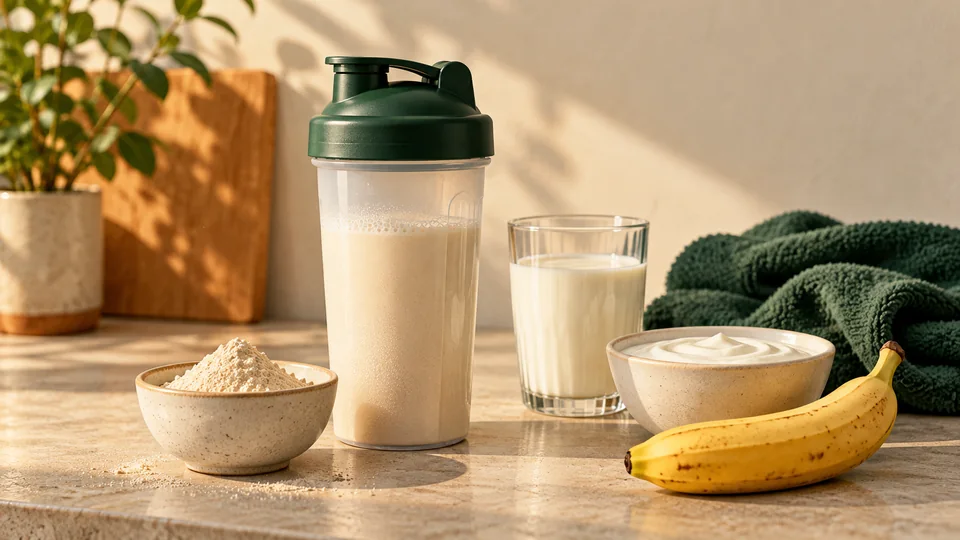
A standard serving is one scoop (roughly 25–30 g of powder, around 20–24 g of protein) in 200–300 ml of cold water or milk. Add the liquid first, then the powder, shake for ten seconds, and you’re done. Water keeps it light; milk makes it creamier and adds a little extra protein. Adjust the liquid to hit the thickness you like. Want a treat? Blend it with a banana and ice — check live chocolate whey prices in Malta before you buy.
Storage
Keep the tub sealed in a cool, dry place away from direct sunlight, and use a dry scoop — moisture is the enemy of any protein powder and causes clumping. Stored properly, it stays fresh and free-flowing right to the bottom of the tub.
Stacking it sensibly
Whey pairs naturally with the rest of a simple routine. It can be used alongside creatine monohydrate and an optional pre-workout before sessions. There’s no need to overcomplicate it — protein, creatine and consistent training carry most of the load.
Buying whey protein in Malta and Cyprus
If you’re shopping in Malta or Cyprus, a few things are worth checking: the protein-per-serving figure (not just the scoop size), the type of whey (isolate or concentrate), an ingredient list you can actually read, and reliable local delivery so you’re not paying eye-watering import fees or waiting weeks.
Why local matters
CapyFuel is a guide and live price-comparison site built for the Mediterranean market specifically — Malta and Cyprus. We don’t sell anything ourselves; instead we track what local retailers actually charge and write honest, EU-claims-only guides: no hype, no medical promises. For a full buyer’s checklist and how the options compare locally, see our guide to the best protein powder in Malta and Cyprus.
For the live numbers behind that guide, see what protein powder actually costs in Malta and Cyprus right now.
Authorised health claims for protein are listed in the official EU health-claims register.
Explore more: best time to take whey · whey protein benefits · whey, lactose & digestion · whey vs plant protein · protein for women · best protein powder in Malta & Cyprus · how much protein you need · isolate vs concentrate · creatine monohydrate · pre-workout · BCAA & amino acids · Whey protein chocolate
Comparing actual products? We read the ingredient declaration of every whey protein stocked in Malta and Cyprus and scored them on protein density, source transparency, additives and amino integrity — see our whey protein reviews.
Frequently asked questions
Is whey protein good for you?
Whey is a complete protein. The exact EU-authorised wording is shown in the box on this page. Protein works best alongside a varied, balanced diet.
Is whey isolate better than concentrate?
Isolate has more protein and less lactose per scoop; concentrate is cheaper and keeps slightly more carbohydrate and fat. Choose the one that suits your stomach and budget.
How much whey should I take a day?
The ISSN position stand (Jäger et al., 2017) states that an overall daily protein intake of 1.4 to 2.0 grams per kilogram of body weight is sufficient for most exercising individuals. A single scoop adds the amount of protein stated on the label.
When should I drink whey protein?
Any time that helps you reach your daily total. A serving can be had around training or with a meal.